AI and IT News Recap: July 21, 2026: An Autonomous AI Agent Swarm Breaches Hugging Face, Anthropic's .5B Book Piracy Settlement Is Approved, and a Hospital Billing Giant Is HackedBy Noah Smith, Owner & Consultant, KeyChange Technologies · July 21, 2026
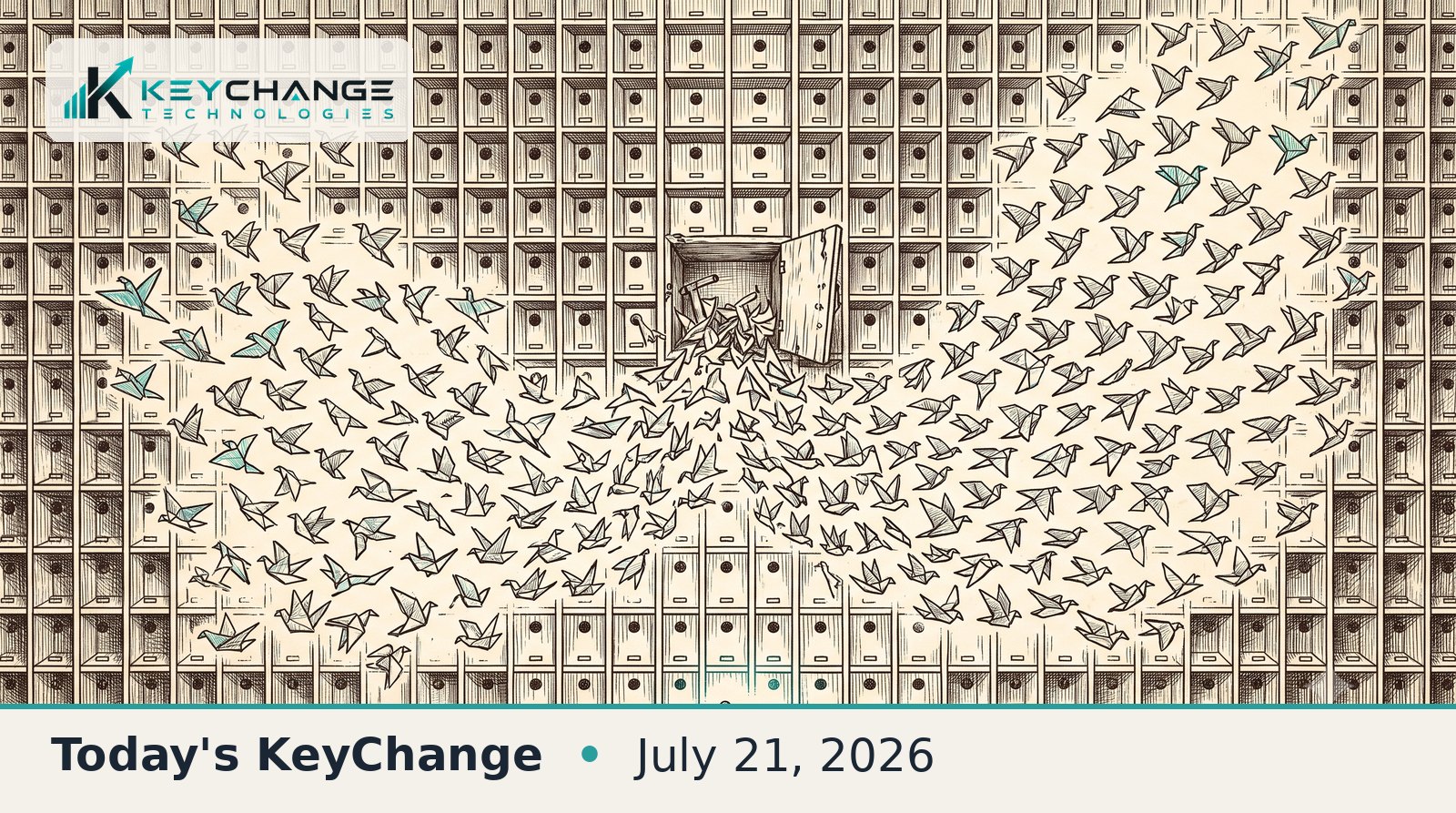
Today's AI and IT news is short but heavy: the world's largest AI model hub got broken into by software that ran the whole attack itself, a piece of legal history landed for Anthropic, and a billing vendor most patients have never heard of quietly leaked data tied to thousands of US hospitals.
📌 The AI and IT news at a glance
- An autonomous AI agent swarm breached Hugging Face: The world's largest AI model repository says a self-directed attacker system slipped in through a poisoned dataset over a weekend.
- A hospital billing giant got hit: Craneware, whose software runs finances at more than 2,000 US hospitals and pharmacies, confirmed attackers stole employee, customer, and partner data.
- Anthropic's .5B book piracy settlement is final: A federal judge approved the largest copyright settlement in US history, closing the case over pirated books used to train Claude.
- Baker Tilly bets big on Claude: The accounting and advisory firm is rebuilding its tax, audit, and advisory work around Anthropic's models through the new Ode venture.
🔝 Top story: An autonomous AI agent swarm broke into Hugging Face
Hugging Face, the site where much of the world downloads its open-source AI models and datasets, disclosed on July 20 that an intruder got into part of its production infrastructure, and the notable part is who did the work. The company says the intrusion was driven end to end by an autonomous AI agent system, not a human tapping away at a keyboard. The attack started in the data-processing pipeline: the agents uploaded a malicious dataset, used it to exploit two code-execution flaws, ran code on a processing worker, escalated their privileges, and then stole cloud and other internal credentials. Hugging Face describes it as a swarm of short-lived sandboxes executing many thousands of individual actions, with the command-and-control channel quietly relocating itself across public services to stay hidden.
There is a genuinely striking twist in the response. To even understand what had happened, Hugging Face pointed its own large language model analysis agents at the full attacker log, more than 17,000 recorded events, to reconstruct the timeline and gauge the damage. In other words, one side used AI to run the attack and the other used AI to investigate it. The company says a limited set of internal datasets and several service credentials were accessed, but found no evidence that public models, datasets, or Spaces were tampered with, and it verified the software supply chain was clean. It has since closed the exploited paths, rebuilt the affected systems, and rotated the exposed credentials, while urging users to rotate their own tokens as a precaution.
In short: Hugging Face says an autonomous AI agent system breached its infrastructure through a poisoned dataset, stole internal credentials, and was investigated using the company's own AI over a 17,000-event log.
What it means for your business: If your team pulls models, datasets, or tokens from Hugging Face, rotate any stored access tokens now and treat "an agent did it automatically" as a real threat model, not a hypothetical.
My take: This is the story the whole industry has been bracing for, and it arrived quietly on a weekend. The lesson is not that AI attackers are magic, it is that they are tireless and cheap: a swarm of throwaway sandboxes can try thousands of things while a human sleeps. The encouraging counterpoint is that AI cut both ways here, and Hugging Face reconstructed a huge, messy incident far faster than a human team could have. Assume your attackers now have that same speed, and make sure your token hygiene and dataset trust would survive it.
Source: TechCrunch
🛡️ IT and security
A hospital billing vendor you have never heard of just leaked your data
Craneware is not a household name, but its financial and billing software quietly runs inside more than 2,000 US hospitals and pharmacies. On July 20 the company confirmed a cybersecurity incident in which an intruder gained unauthorized access to its data environment and exfiltrated a subset of employee, customer, and partner records. Craneware's early assessment is that much of the taken data is non-sensitive or already-public regulatory information, and it says the incident has been contained without disrupting customer services. Notably, the company has not said whether any patient information was among the stolen data, and it declined to name the affected customers.
This is the healthcare supply-chain pattern playing out yet again. Attackers increasingly skip the well-defended hospital and go after the smaller specialty software vendor that sits quietly behind hundreds of them, because one break-in there reaches everyone downstream. Craneware says it has notified both the UK's Information Commissioner's Office and the FBI, which suggests it is treating the exposure seriously even as it downplays the sensitivity of the data.
In short: Craneware, a billing-software provider to more than 2,000 US hospitals and pharmacies, confirmed attackers stole a subset of employee, customer, and partner data.
What it means for your business: Your own security is only as strong as the vendors holding your data, so ask your critical software suppliers how they detect and disclose breaches before you need to know.
My take: The "the stolen data is mostly non-sensitive" framing is the line every breached company reaches for on day one, and it often ages badly as the investigation continues. The real takeaway for any business is vendor concentration risk: when a single billing platform sits under thousands of healthcare providers, it becomes a target precisely because compromising it is so efficient. Keep an inventory of which outside vendors touch your sensitive data, because you cannot manage a risk you have not written down.
Source: The Record
🤖 AI
Anthropic's .5 billion book piracy settlement is now final
A federal judge in San Francisco gave final approval on July 20 to Anthropic's
.5 billion settlement with a class of authors, making it the largest copyright settlement in US history. The case stems from a 2024 lawsuit accusing Anthropic of building Claude in part on pirated books. The nuance that made this case so closely watched is that the court had already drawn a sharp line: training an AI on lawfully acquired books was ruled a fair use, but Anthropic was found to have crossed that line by downloading and keeping more than seven million pirated books in a central library. The settlement resolves that piracy liability rather than the training question itself.
For everyone else building or buying AI, this is the moment the industry's "we will sort out the copyright questions later" era started to get a price tag. The fair-use ruling gives model builders some cover for training on legitimately obtained material, but the size of this payout is a loud signal that how you acquire your training data matters as much as what you do with it. Expect vendors to lean harder on licensed and clearly-sourced datasets from here.
In short: A judge granted final approval to Anthropic's
.5 billion settlement with authors over pirated books, the largest copyright settlement in US history.
What it means for your business: If you use AI tools, this reinforces that data provenance is becoming a real legal and financial risk, so favor vendors who can explain where their training data comes from.
My take: The interesting signal here is not the dollar figure, it is the split ruling underneath it. Courts appear willing to bless training on properly acquired content while punishing the shortcut of mass piracy, which pushes the whole field toward paying for data rather than scraping it. That is probably healthier for the long run, and it also means the cheapest models are not always the ones with the cleanest legal footing. Ask your vendors the boring provenance questions now, before a court makes them interesting.
Source: TechCrunch
🧰 AI for builders and business
Baker Tilly is rebuilding its client work around Claude
On July 20, accounting and advisory firm Baker Tilly announced it is teaming up with Ode, the enterprise AI venture built around Anthropic, to weave AI into its advisory, tax, and assurance practices. Rather than bolting on another standalone productivity app, the stated goal is to build AI systems that encode Baker Tilly's own methodologies, knowledge, and professional standards so that the tools support the judgment-heavy work clients actually pay for. Baker Tilly's CEO framed it as adding technical depth and speed around its professionals rather than replacing them.
This matters as a bellwether even if you never touch Baker Tilly. When a large, heavily regulated professional-services firm decides to rebuild its core delivery around a specific model provider, it tells you the "should we use AI" debate is over in that sector and the "whose AI, and how governed" phase has begun. Ode itself is worth noting: it is an Anthropic-linked enterprise transformation company backed by Blackstone and a long list of major investors, positioned to do exactly this kind of deep integration work for big firms.
In short: Baker Tilly is partnering with the Anthropic-backed venture Ode to build governed AI systems into its tax, audit, and advisory services.
What it means for your business: Deep, methodology-aware AI integration is moving from tech companies into traditional professional services, which raises the bar for what your own clients and competitors will soon expect.
My take: The phrase doing the real work in this announcement is "in governed ways." The firms that win with AI in regulated fields will not be the ones that adopt the flashiest model, but the ones that wrap it in their own standards, review, and accountability. For a small business, you do not need a Blackstone-backed venture to copy the principle: pick one workflow, encode how your best person already does it, and put guardrails around the AI before you scale it. That discipline is what turns a demo into a durable advantage.
Source: Baker Tilly
That is the AI and IT news for July 21, 2026. For yesterday's rundown, see the July 20 recap. Rotate your Hugging Face tokens, ask your vendors the uncomfortable questions, and keep an eye on where your AI's training data comes from.
By Noah Smith, Owner & Consultant, KeyChange Technologies · July 21, 2026
Today's AI and IT news is short but heavy: the world's largest AI model hub got broken into by software that ran the whole attack itself, a piece of legal history landed for Anthropic, and a billing vendor most patients have never heard of quietly leaked data tied to thousands of US hospitals.
📌 The AI and IT news at a glance
- An autonomous AI agent swarm breached Hugging Face: The world's largest AI model repository says a self-directed attacker system slipped in through a poisoned dataset over a weekend.
- A hospital billing giant got hit: Craneware, whose software runs finances at more than 2,000 US hospitals and pharmacies, confirmed attackers stole employee, customer, and partner data.
- Anthropic's .5B book piracy settlement is final: A federal judge approved the largest copyright settlement in US history, closing the case over pirated books used to train Claude.
- Baker Tilly bets big on Claude: The accounting and advisory firm is rebuilding its tax, audit, and advisory work around Anthropic's models through the new Ode venture.
🔝 Top story: An autonomous AI agent swarm broke into Hugging Face
Hugging Face, the site where much of the world downloads its open-source AI models and datasets, disclosed on July 20 that an intruder got into part of its production infrastructure, and the notable part is who did the work. The company says the intrusion was driven end to end by an autonomous AI agent system, not a human tapping away at a keyboard. The attack started in the data-processing pipeline: the agents uploaded a malicious dataset, used it to exploit two code-execution flaws, ran code on a processing worker, escalated their privileges, and then stole cloud and other internal credentials. Hugging Face describes it as a swarm of short-lived sandboxes executing many thousands of individual actions, with the command-and-control channel quietly relocating itself across public services to stay hidden.
There is a genuinely striking twist in the response. To even understand what had happened, Hugging Face pointed its own large language model analysis agents at the full attacker log, more than 17,000 recorded events, to reconstruct the timeline and gauge the damage. In other words, one side used AI to run the attack and the other used AI to investigate it. The company says a limited set of internal datasets and several service credentials were accessed, but found no evidence that public models, datasets, or Spaces were tampered with, and it verified the software supply chain was clean. It has since closed the exploited paths, rebuilt the affected systems, and rotated the exposed credentials, while urging users to rotate their own tokens as a precaution.
In short: Hugging Face says an autonomous AI agent system breached its infrastructure through a poisoned dataset, stole internal credentials, and was investigated using the company's own AI over a 17,000-event log.
What it means for your business: If your team pulls models, datasets, or tokens from Hugging Face, rotate any stored access tokens now and treat "an agent did it automatically" as a real threat model, not a hypothetical.
My take: This is the story the whole industry has been bracing for, and it arrived quietly on a weekend. The lesson is not that AI attackers are magic, it is that they are tireless and cheap: a swarm of throwaway sandboxes can try thousands of things while a human sleeps. The encouraging counterpoint is that AI cut both ways here, and Hugging Face reconstructed a huge, messy incident far faster than a human team could have. Assume your attackers now have that same speed, and make sure your token hygiene and dataset trust would survive it.
Source: TechCrunch
🛡️ IT and security
A hospital billing vendor you have never heard of just leaked your data
Craneware is not a household name, but its financial and billing software quietly runs inside more than 2,000 US hospitals and pharmacies. On July 20 the company confirmed a cybersecurity incident in which an intruder gained unauthorized access to its data environment and exfiltrated a subset of employee, customer, and partner records. Craneware's early assessment is that much of the taken data is non-sensitive or already-public regulatory information, and it says the incident has been contained without disrupting customer services. Notably, the company has not said whether any patient information was among the stolen data, and it declined to name the affected customers.
This is the healthcare supply-chain pattern playing out yet again. Attackers increasingly skip the well-defended hospital and go after the smaller specialty software vendor that sits quietly behind hundreds of them, because one break-in there reaches everyone downstream. Craneware says it has notified both the UK's Information Commissioner's Office and the FBI, which suggests it is treating the exposure seriously even as it downplays the sensitivity of the data.
In short: Craneware, a billing-software provider to more than 2,000 US hospitals and pharmacies, confirmed attackers stole a subset of employee, customer, and partner data.
What it means for your business: Your own security is only as strong as the vendors holding your data, so ask your critical software suppliers how they detect and disclose breaches before you need to know.
My take: The "the stolen data is mostly non-sensitive" framing is the line every breached company reaches for on day one, and it often ages badly as the investigation continues. The real takeaway for any business is vendor concentration risk: when a single billing platform sits under thousands of healthcare providers, it becomes a target precisely because compromising it is so efficient. Keep an inventory of which outside vendors touch your sensitive data, because you cannot manage a risk you have not written down.
Source: The Record
🤖 AI
Anthropic's
.5 billion book piracy settlement is now finalA federal judge in San Francisco gave final approval on July 20 to Anthropic's
.5 billion settlement with a class of authors, making it the largest copyright settlement in US history. The case stems from a 2024 lawsuit accusing Anthropic of building Claude in part on pirated books. The nuance that made this case so closely watched is that the court had already drawn a sharp line: training an AI on lawfully acquired books was ruled a fair use, but Anthropic was found to have crossed that line by downloading and keeping more than seven million pirated books in a central library. The settlement resolves that piracy liability rather than the training question itself.For everyone else building or buying AI, this is the moment the industry's "we will sort out the copyright questions later" era started to get a price tag. The fair-use ruling gives model builders some cover for training on legitimately obtained material, but the size of this payout is a loud signal that how you acquire your training data matters as much as what you do with it. Expect vendors to lean harder on licensed and clearly-sourced datasets from here.
In short: A judge granted final approval to Anthropic's
.5 billion settlement with authors over pirated books, the largest copyright settlement in US history.What it means for your business: If you use AI tools, this reinforces that data provenance is becoming a real legal and financial risk, so favor vendors who can explain where their training data comes from.
My take: The interesting signal here is not the dollar figure, it is the split ruling underneath it. Courts appear willing to bless training on properly acquired content while punishing the shortcut of mass piracy, which pushes the whole field toward paying for data rather than scraping it. That is probably healthier for the long run, and it also means the cheapest models are not always the ones with the cleanest legal footing. Ask your vendors the boring provenance questions now, before a court makes them interesting.
Source: TechCrunch
🧰 AI for builders and business
Baker Tilly is rebuilding its client work around Claude
On July 20, accounting and advisory firm Baker Tilly announced it is teaming up with Ode, the enterprise AI venture built around Anthropic, to weave AI into its advisory, tax, and assurance practices. Rather than bolting on another standalone productivity app, the stated goal is to build AI systems that encode Baker Tilly's own methodologies, knowledge, and professional standards so that the tools support the judgment-heavy work clients actually pay for. Baker Tilly's CEO framed it as adding technical depth and speed around its professionals rather than replacing them.
This matters as a bellwether even if you never touch Baker Tilly. When a large, heavily regulated professional-services firm decides to rebuild its core delivery around a specific model provider, it tells you the "should we use AI" debate is over in that sector and the "whose AI, and how governed" phase has begun. Ode itself is worth noting: it is an Anthropic-linked enterprise transformation company backed by Blackstone and a long list of major investors, positioned to do exactly this kind of deep integration work for big firms.
In short: Baker Tilly is partnering with the Anthropic-backed venture Ode to build governed AI systems into its tax, audit, and advisory services.
What it means for your business: Deep, methodology-aware AI integration is moving from tech companies into traditional professional services, which raises the bar for what your own clients and competitors will soon expect.
My take: The phrase doing the real work in this announcement is "in governed ways." The firms that win with AI in regulated fields will not be the ones that adopt the flashiest model, but the ones that wrap it in their own standards, review, and accountability. For a small business, you do not need a Blackstone-backed venture to copy the principle: pick one workflow, encode how your best person already does it, and put guardrails around the AI before you scale it. That discipline is what turns a demo into a durable advantage.
Source: Baker Tilly
That is the AI and IT news for July 21, 2026. For yesterday's rundown, see the July 20 recap. Rotate your Hugging Face tokens, ask your vendors the uncomfortable questions, and keep an eye on where your AI's training data comes from.