AI and IT News Recap: July 1, 2026: Hijacked AI Agents, Two Critical Flaws Under Active Attack, and China's Biggest Home-Grown Model
By Noah Smith, Owner & Consultant, KeyChange Technologies · July 1, 2026
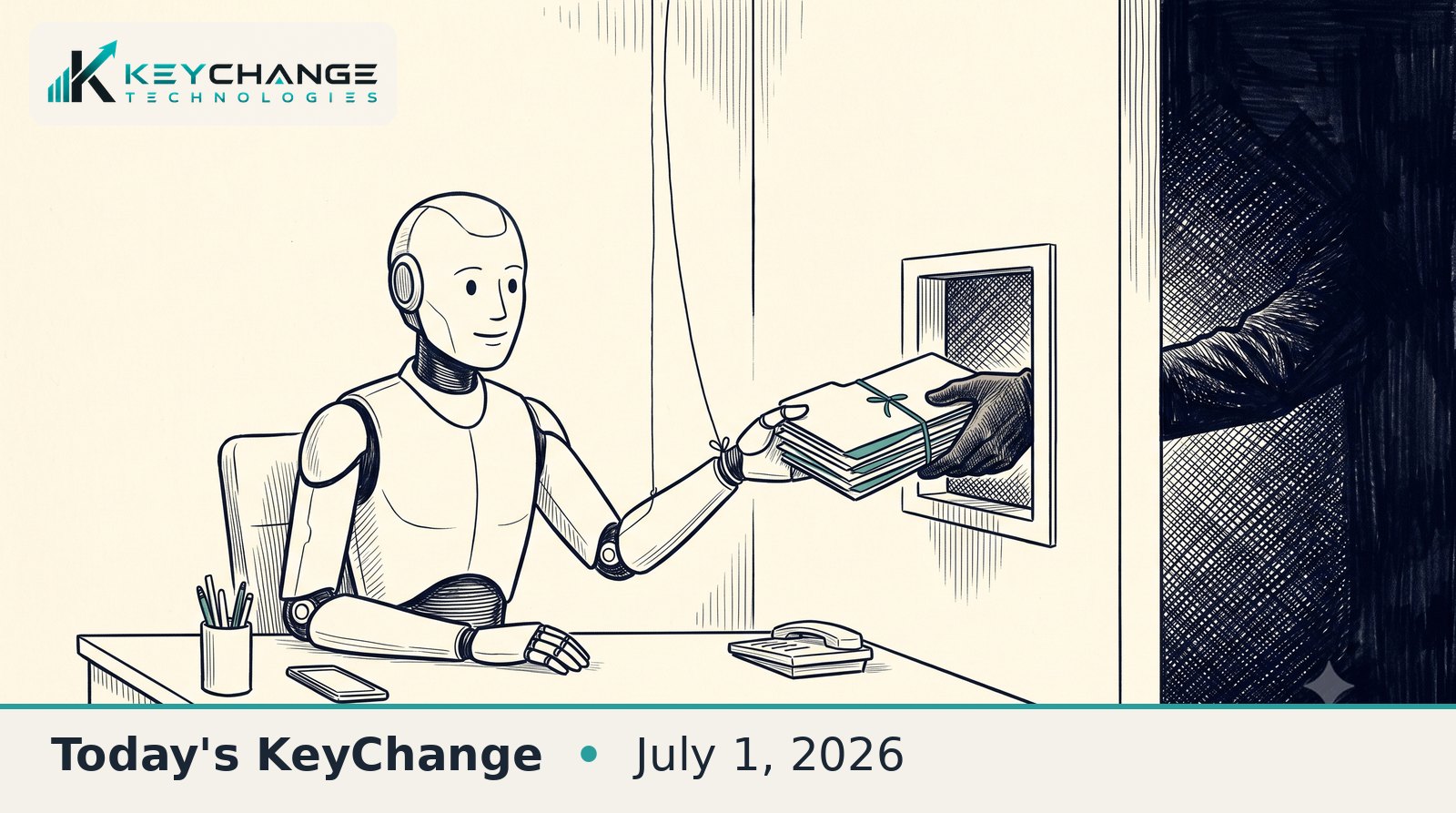
Yesterday was quiet on flashy model launches but loud on something more useful to know about: AI agents got picked apart. This edition of the AI and IT news recap leads with a Microsoft warning that your helpful office assistant can be quietly turned into an insider, then walks through two actively exploited critical flaws, a wave of AI-app security research, China's biggest home-grown model yet, and a couple of tools worth a look.
📌 The AI and IT news at a glance
- 🔝 Microsoft: a poisoned tool description can turn your AI agent into a data leaker, and no alarm fires.
- 🤖 Meituan open-sources LongCat-2.0, a 1.6 trillion-parameter model trained entirely on Chinese chips.
- 🤖 Enterprises start treating AI "tokens" like a cloud bill as agents scale usage.
- 🛡️ SimpleHelp flaw (CVSS 10.0) is under active attack, dropping two new info-stealers.
- 🛡️ Oracle E-Business Suite payments flaw (CVSS 9.8) exploited in the wild over the weekend.
- 🛡️ Two-thirds of 444 iOS AI apps were leaking their AI keys in plain network traffic.
- 🛡️ "BioShocking" tricks ChatGPT Atlas, Comet, and Claude's browser into handing over your logins.
- 🛡️ "GuardFall" walks past the safety checks in 10 of 11 open-source AI coding agents.
- 🧰 Google makes its "Nano Banana" personalized image generation free for eligible US users.
- 🧰 YouGov ships Model Context Protocol support so its research data plugs into AI agents.
🔝 Top story: Microsoft warns a poisoned "tool description" can make your AI agent quietly leak company data
New research from Microsoft Incident Response and its Defender security team shows how an attacker can hijack an AI agent that acts on a user's behalf using nothing more fancy than a poisoned tool description. The unsettling part is that the agent never breaks a rule. It reads what looks like a normal instruction attached to one of its tools, then follows it, and every step in the chain looks routine. In a default setup, no alarm may fire at all.
This matters more now than it would have a year ago because agents no longer just read and summarize. Microsoft 365 Copilot can send email, create files, and change calendars. Custom agents built in Copilot Studio or Azure AI Foundry can reach into business systems and run multi-step jobs on their own. The same injection trick that used to only bias a summary can now trigger a real action, like handing a folder of documents to an outsider, because the agent has the access and the autonomy to do it.
In short: Microsoft demonstrated that a booby-trapped tool description can steer an AI agent into leaking data while every action still looks legitimate.
What it means for your business: If your team is rolling out Copilot agents or custom AI assistants that can act (not just chat), assume the tools and data those agents touch are part of your attack surface, and insist on logging, approvals for sensitive actions, and least-privilege access before you flip anything on.
My take: This is the story that ties the whole day together. We spent years worrying about what a model would say. The real risk now is what an agent will do on your behalf when someone slips it a bad instruction. The fix is not exotic: treat agents like junior employees with system access, give them the least they need, and make their actions reviewable. Convenience without guardrails is how this goes wrong.
Source: The Hacker News: Microsoft Warns Poisoned MCP Tool Descriptions Can Make AI Agents Leak Data
🤖 AI generally
Meituan open-sources LongCat-2.0, a 1.6 trillion-parameter model trained entirely on Chinese chips
Chinese company Meituan open-sourced LongCat-2.0, a 1.6 trillion-parameter large language model it says was both pre-trained and run for inference entirely on domestic semiconductor hardware, using a roughly 50,000-card cluster of home-grown AI accelerators. The model carries a 1 million-token context window, and Meituan claims performance comparable to Google's Gemini 3.1 Pro. Because the weights are open, anyone can download and run it.
The detail that has people paying attention is the training claim. Earlier Chinese efforts leaned on domestic chips mostly for inference while still using Nvidia hardware for the heavy pre-training. Meituan is claiming the full pipeline ran on local silicon, which, if it holds up to scrutiny, is a meaningful signal about how far China's chip-independence push has come despite export controls.
In short: Meituan released a 1.6 trillion-parameter open-weight model it says was fully trained on Chinese-made chips, not Nvidia.
What it means for your business: Cheap, capable, open-weight models keep arriving, which is good for anyone who wants to run AI on their own terms, but the geopolitics of where chips and models come from will increasingly shape procurement and compliance decisions.
My take: The headline number is the parameters, but the story is the supply chain. Open weights mean this ends up in the global toolkit fast. If your AI strategy assumes the frontier is only ever American and only ever closed, keep an eye on releases like this, because "good enough and free" changes the math for a lot of everyday workloads.
Companies start watching AI "token" costs the way they watch cloud bills
As AI agents move from pilots into real workflows, businesses are beginning to manage token consumption (the unit AI providers bill on) with the same discipline they once brought to cloud spend. The Wall Street Journal reports that finance and engineering teams are now tracking these costs closely, and Goldman Sachs reportedly expects AI agents to push token consumption up roughly 24 times over the next four years.
The reason is simple: with agents, every prompt, every automated step, and every autonomous decision generates compute that someone pays for. A workflow that looked cheap as a single chat query can get expensive when an agent runs it hundreds of times a day.
In short: Enterprises are starting to treat AI token usage as a serious, recurring cost line rather than a rounding error.
What it means for your business: Before you turn an AI pilot into an always-on agent, get visibility into per-task cost and set usage limits, because the bill scales with adoption, not with headcount.
My take: This is the un-sexy story that will hit real budgets. The mistake I see coming is teams celebrating an agent that "works" without ever checking what it costs per run. Measure cost per outcome early. An agent that saves an hour but burns forty dollars a task is a decision, not a default.
Source: Tech Startups: Top Tech News Today, June 30, 2026 (Companies Brace for AI Token Costs)
🛡️ IT and security
SimpleHelp flaw (CVSS 10.0) is under active attack and dropping new stealers
An unknown attacker is exploiting a maximum-severity flaw in SimpleHelp, the remote-support tool, tracked as CVE-2026-48558 (CVSS 10.0). It is an authentication bypass in the OpenID Connect flow that lets an unauthenticated attacker forge a token and land a fully authenticated technician session. From there, according to Blackpoint Cyber, the intruders deployed two previously unreported malware families: TaskWeaver, an obfuscated Node.js loader disguised as jquery.js, and Djinn Stealer, a credential harvester that targets Windows, macOS, and Linux.
Remote-support software is a high-value target precisely because it is trusted and sits deep inside networks. A max-severity, actively exploited flaw in one is the kind of thing to act on today, not next sprint.
In short: A perfect-10 SimpleHelp authentication bypass is being exploited in the wild to install two new info-stealers across Windows, Mac, and Linux.
What it means for your business: If you or your IT provider use SimpleHelp, patch immediately and check for unexpected technician sessions, because this one requires no credentials to abuse.
My take: Remote-access tools are the master key to a network, which is exactly why attackers love them. "CVSS 10.0, actively exploited" is about as loud as an alarm gets. If it is in your stack, this jumps the queue.
Source: The Hacker News: Attackers Exploit SimpleHelp CVE-2026-48558 to Deploy TaskWeaver and Djinn Stealer
Oracle E-Business Suite payments flaw (CVSS 9.8) exploited in the wild
A critical flaw in Oracle E-Business Suite, CVE-2026-46817 (CVSS 9.8), is being actively exploited, according to Defused Cyber, which observed an attacker abusing it over the weekend. The bug is an improper privilege management and authentication weakness in Oracle Payments that lets an unauthenticated attacker with network access take over a vulnerable instance. It affects versions 12.2.3 through 12.2.15, and Oracle shipped a patch in its most recent Critical Patch Update.
In short: An unauthenticated takeover flaw in Oracle Payments is now under active exploitation, and a patch is already available.
What it means for your business: If you run Oracle E-Business Suite, confirm the latest Critical Patch Update is applied, especially on any internet-facing instance handling payments.
My take: The patch existed before the attacks started, which is the usual and frustrating pattern. Exploitation of enterprise back-office software is quieter than a flashy breach but arguably worse, because payments and financial data are the crown jewels. Patch cadence on ERP is not glamorous, and it is exactly what saves you here.
Source: The Hacker News: Oracle E-Business Suite Flaw CVE-2026-46817 Actively Exploited in the Wild
Two-thirds of iOS AI apps were leaking their AI keys in plain traffic
Researchers at Wake Forest University tested 444 AI chatbot apps for iPhone and found that 282 of them, nearly two-thirds, exposed paid AI access right there in their network traffic: a plaintext API key, a reusable token, or a backend that accepted requests with no key at all. Anyone watching the traffic could then send model requests on the developer's account, and the developer pays the bill. Three months after being warned, only 28% of the developers had fixed it.
In short: A study found 282 of 444 iOS AI apps leaking the credentials that let strangers run up the developer's AI bill.
What it means for your business: If your company ships an app that calls an AI service, never embed the key in the client, route calls through your own backend, and rotate any key that has ever lived in an app binary.
My take: This is a wallet story as much as a security one. Leak your OpenAI or Gemini key and you have handed a stranger your credit card for compute. It is an easy mistake and an easy fix, and the fact that most developers ignored the warning for three months is the depressing part.
Source: The Hacker News: 282 iOS AI Apps Leak API Keys and Open AI Proxy Access in Network Traffic Study
"BioShocking" tricks AI browsers into handing over your logins
Security firm LayerX showed a technique it calls BioShocking that convinces an AI browser it is playing a game, and gets it to copy the user's credentials and send them to an attacker. The trick worked against six AI browsers and assistants, including OpenAI's ChatGPT Atlas, Perplexity's Comet, and Anthropic's Claude browser extension. The root cause is familiar: in agent mode, the web page's content and your own instructions arrive as one stream of text, so a malicious page can slip in commands dressed up as harmless game rules, and the agent cannot reliably tell the difference. Researchers call this indirect prompt injection.
In short: A "let's play a game" ruse got several AI browsers to leak the user's saved logins to an attacker.
What it means for your business: AI browsers in "agent mode" can act on sites your staff are already logged into, so treat them as powerful and still-immature, and keep them away from banking, admin panels, and anything sensitive for now.
My take: AI browsers are genuinely useful and genuinely not ready to be trusted with your logged-in sessions. The whole value proposition (it can act for you) is also the whole risk (it can be tricked into acting against you). Fun demo, serious lesson: agent mode belongs on low-stakes tasks until this class of attack is solved.
Source: The Hacker News: New BioShocking Attack Tricks AI Browsers Into Leaking User Credentials
"GuardFall" slips past the safety checks in AI coding agents
Adversa AI published a bypass it calls GuardFall that walks straight past the command that is supposed to stop an AI coding agent from running something dangerous, using a shell trick that has been public for decades. It worked against ten of the eleven popular open-source coding and computer-use agents the firm tested; only one, "Continue," was built to defend against it. The flaw is that the agents check each command as plain text against a blocklist, while bash quietly rewrites that text before running it. Because these agents run shell commands with your full account access, pointing one at a booby-trapped repository can quietly run a command that wipes files or steals SSH keys and cloud credentials.
In short: A decades-old shell-escaping trick defeats the safety filters in 10 of 11 open-source AI coding agents.
What it means for your business: If your developers use AI coding agents, be careful pointing them at untrusted repositories or packages, and run them with scoped credentials rather than your full account.
My take: The "vibe coding" boom shipped a lot of agents that run real shell commands, and this shows how thin some of the guardrails are. The lesson is the same one security folks have preached forever: a blocklist you can trivially rephrase around is not a safety control. Sandbox these agents and limit what their account can touch.
Source: The Hacker News: GuardFall Exposes Open-Source AI Coding Agents to Decades-Old Shell Injection Risks
🧰 New software and AI tooling
Google makes "Nano Banana" personalized image generation free for eligible US users
Google moved its personalized image-generation feature, powered by the model nicknamed Nano Banana, out from behind paid tiers and into the free Gemini app for eligible users in the US. The feature lets you generate customized images, and pushing it to the free tier is a clear play to grow adoption and pull more casual users into Gemini.
In short: Google's Nano Banana personalized image generation is now free for eligible US Gemini users.
What it means for your business: For small teams and solo owners, that is capable image generation for marketing and social content at no added cost, worth trying before you pay for a separate tool.
My take: The image-generation price floor keeps dropping toward zero. If you are paying for a standalone generator for basic marketing images, it is worth checking whether the free tools now cover your needs. Just keep the usual caveats in mind on brand consistency and rights.
Source: Tech Startups: Top Tech News Today, June 30, 2026 (Google Expands Nano Banana to Free Users)
YouGov adds Model Context Protocol support so its data plugs into AI agents
Research and data company YouGov launched support for the Model Context Protocol (MCP), the emerging standard for connecting external data and tools to AI models and agents. The move lets clients pipe YouGov's research data directly into AI-native workflows and agent environments, aimed at data scientists, model builders, and enterprise insights teams.
In short: YouGov now speaks MCP, letting its research data flow straight into AI agents and workflows.
What it means for your business: MCP is quietly becoming the plug that connects your tools and data to AI assistants, so when a vendor adds it, integrating their data into your own AI workflows gets a lot easier.
My take: Watch the MCP trend more than this single announcement. As more vendors add MCP support, wiring your business data into AI agents shifts from a custom project to a connector you switch on. That is the plumbing that will make the next wave of business AI actually useful, and, per today's top story, it is also the plumbing you need to secure.
Source: Insurance Edge: AI Tools & Tech: YouGov Launches Support for MCP
That is the AI and IT news for July 1, 2026. For yesterday's edition, see our June 30 recap, and the June 29 recap before it.